
Worming: Worming Programmes

A diagnostic-led, targeted worming programme and only worming your horse when necessary is better for your horse and reduces the risk of resistance to the ingredients used in wormers.
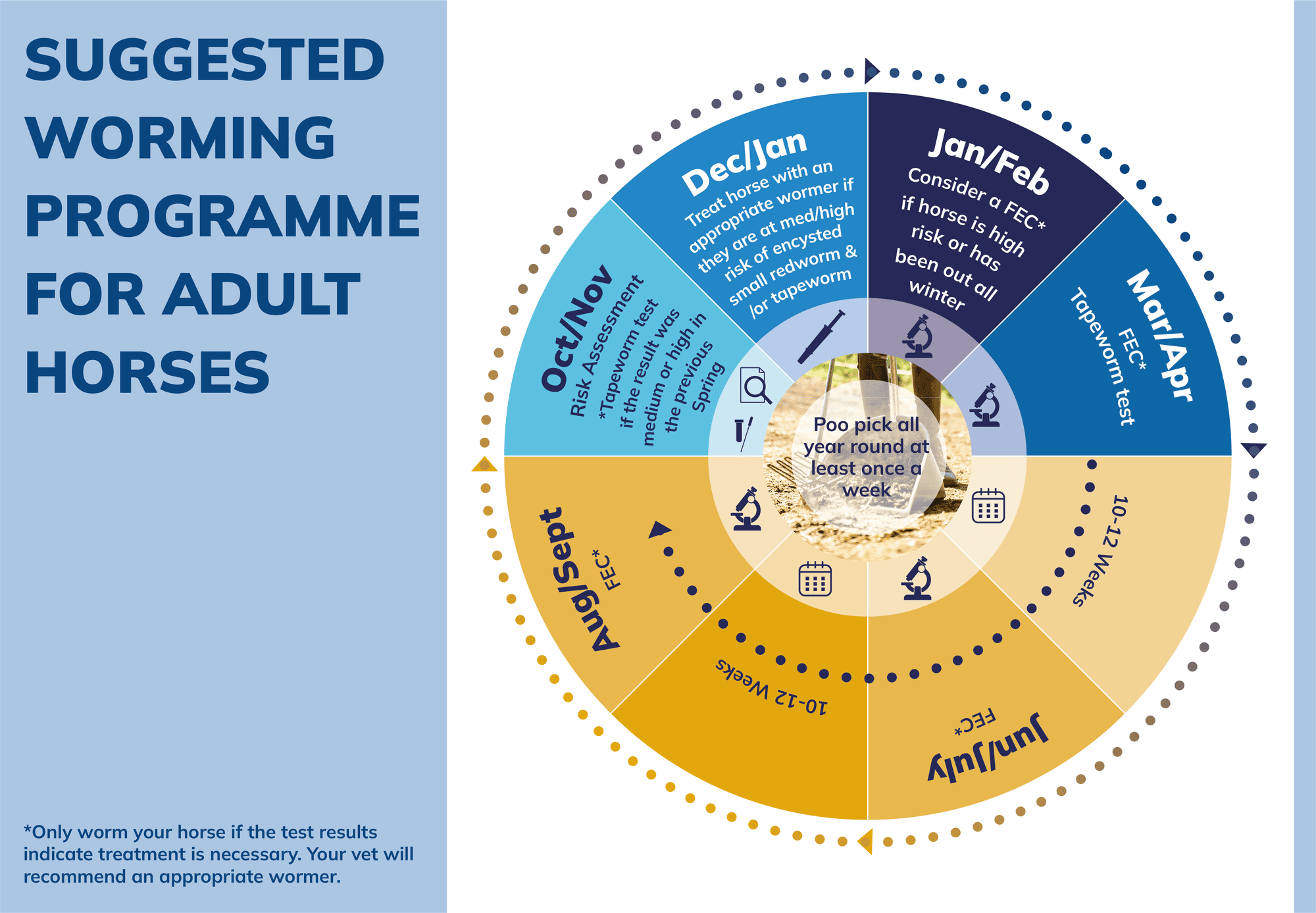
A basic targeted worming programme
The worming programme for individual horses may vary depending on their age, pasture management, previous worming history and worm burden. However, a basic targeted worming programme for an adult horse may look like this:
- January/February – Consider a Faecal worm egg count if your horse is high risk or has lived out all winter.
- March/April – Carry out a faecal worm egg count and a tapeworm saliva test. Tapeworm cannot be identified in a worm egg count.
- Summer grazing season (March – September): Carry out a faecal worm egg count at least every 12 weeks. Your vet may recommend more frequent testing in some situations.
- Once the grazing season is over and the weather starts to get colder (October – December) – Carry out a risk assessment for the presence of encysted small redworm and retest for tapeworm if the result of the Spring saliva test was medium or high. These tests will determine whether you need to treat your horse for either of these parasites, neither of which can be identified using a faecal worm egg count. A small redworm blood test may be recommended by your vet if the risk assessment is low.
- December/January – treat your horse with an appropriate wormer if they are at medium or high risk of tapeworm and/or encysted small redworm.
If any tests throughout the year indicate that your horse needs to be treated, your vet will be able to recommend an appropriate wormer.
If the worming history of a horse is unknown or for new arrivals on the yard, we recommend performing a Faecal Egg Count Reduction Test when treating once with moxidectin before turning the horse out onto pasture. This avoids the risk of introducing moxidectin-resistant parasites onto the pasture.
Things you can do to help reduce your horse’s worm burden
By far the easiest, most effective and most important management procedure that you should do for your horse’s worming programme and health is regular poo-picking. Physically removing the droppings breaks the parasite lifecycle by taking away the worm eggs and developing larvae from the pasture before they are ingested by your horse.
There are also other things you can do to help reduce your horse’s worm burden, such as rotating grazing paddocks, not overstocking pasture and grazing horses with other livestock. Find out more Worming: Top Tips For Worm Control – Horse Health Programme
The worming of foals and horses up to two years old differs from that of adult horses. Speak to your vet for advice on worming youngstock.
Faecal Egg Count Reduction Tests – why they are important
The faecal egg reduction reduction test (FECRT) is the only sure way that you can tell if the wormer (anthelmintic) that you are using to treat small redworms is effective, or if the worms have developed resistance to the drug. If the worms have developed resistance, the wormer won’t be working as well as it should, and there is a risk that your horse will accumulate dangerous numbers of redworms.
- Ideally you should perform a FECRT once a year (in the Spring, Summer or Autumn) when a routine faecal egg count from your horse is high e.g. more that 4-500 eggs per gram.
- If your horse is grazing pasture with other horses which also have high worm egg counts, then the test should be done simultaneously with some or all of the other horses that have high counts.
- Ideally, you should perform the test on at least five horses in the herd – the higher the worm egg counts and the more horses that you can test, the more reliable the results will be. However, it is still valuable to do the FECRT on individual horses on a pasture or small groups of horses if they are grazing the same pasture.
- Your vet or SQP can advise you about exactly how to do the FECRT, but in short, it involves running a faecal egg count just before giving your horse a wormer and then repeating another faecal egg count 14 days later. If the anthelmintic is working well, then there should be a reduction in the egg count of at least 90-95%, whereas if there is a resistance problem, the reduction will be less than 90%.
- It is really important that you administer the correct dose of wormer (anthelmintic drug), based on the weight of the horse. Your vet can help you with how to assess your horse’s weight.
- There are three main types of anthelmintic drugs that are commonly used to control redworms – the benzimidazoles, the pyrimidines and the macrocyclic lactones (includes ivermectin and moxidectin). You should discuss which drug class it would be appropriate to test with your vet or SQP.
Membership of the Horse Health Programme provides 4 faecal worm egg counts a year. Three of these can be used through the gazing season for a faecal worm egg count – for example in March, June and September and then the remaining one can be used for a Faecal Egg Count Reduction Test, so there is no additional cost for carrying out this test if you use one of the egg counts included with your membership.